
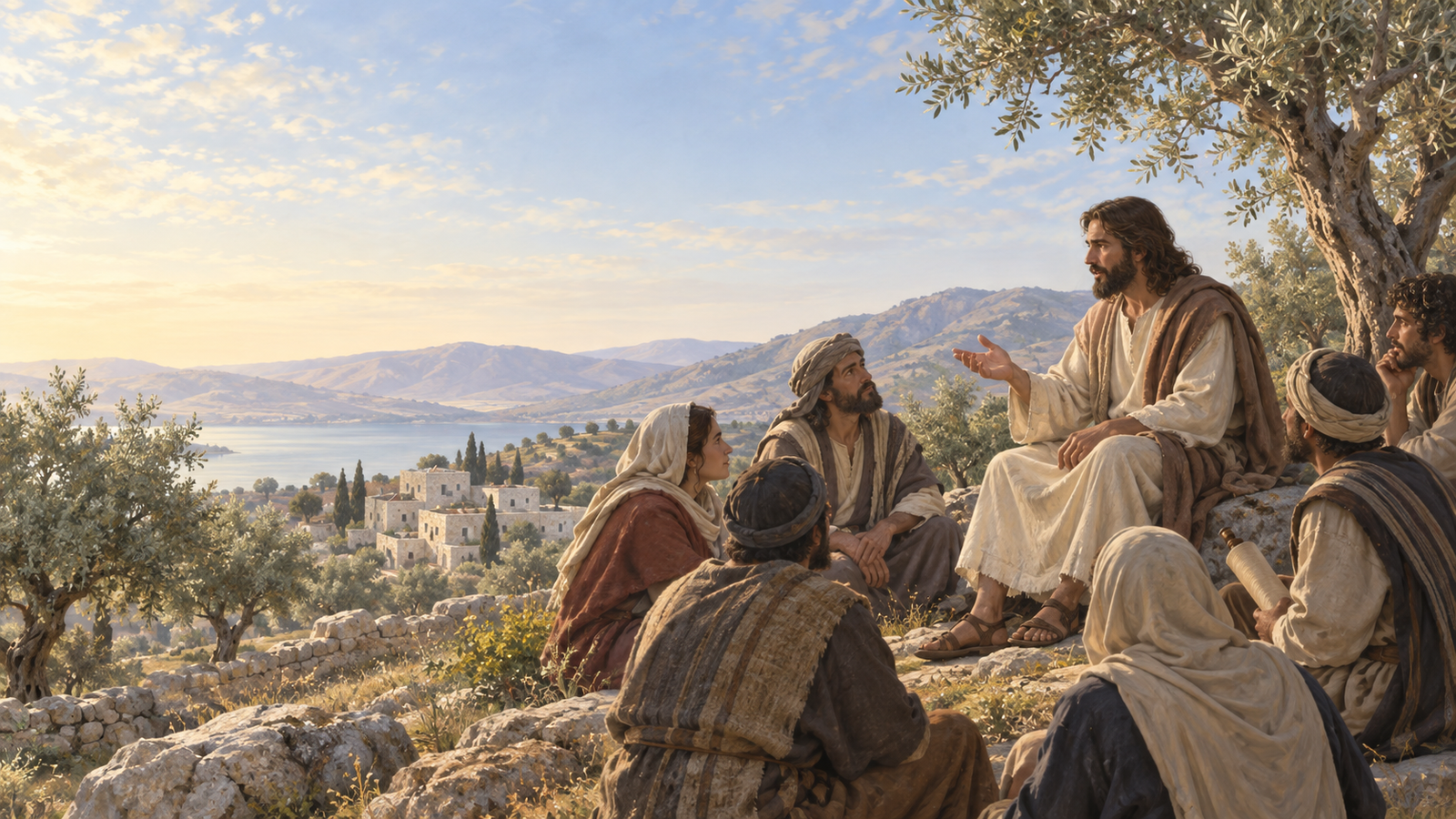
Jesus of Nazareth was born into the Jewish people, formed by Israel’s Scriptures, and lived in the world of Second Temple Judaism. He went to Jerusalem for Passover with his family (Luke 2:41–52), read from Isaiah in a synagogue (Luke 4:16–21), taught from the Torah and the Prophets, and attended Jewish festivals (John 7:2–14; 10:22–39).
That does not make Jesus less important for Christians. It helps us hear him more truly. When Jesus speaks about the kingdom of God, mercy, holiness, prayer, the Temple, Sabbath, Scripture, Israel, and the nations, he speaks from within the story God gave to Israel.
“Do not think that I have come to abolish the Law or the Prophets. I have not come to abolish them but to fulfill them.” — Matthew 5:17
The world Jesus lived in
The Second Temple stood in Jerusalem from the late sixth century BC until Rome destroyed it in AD 70. In Jesus’ lifetime it was the central place of sacrifice, pilgrimage, prayer, and national hope. Yet Jewish life was not limited to Jerusalem. Families gathered in synagogues, kept Sabbath, heard Scripture, marked festivals, and practiced faithfulness to the God of Israel in homes, villages, and towns.
Roman power shaped the land, but the political map needs care. Herod the Great ruled Judea with Roman backing until 4 BC. After his death, his son Herod Antipas governed Galilee and Perea, where much of Jesus’ ministry took place. Judea, including Jerusalem, came under Roman administration; Pontius Pilate served there during Jesus’ public ministry. Roman rule is real context, but a single sentence about a uniformly occupied country hides important differences.
A Jewish world with real diversity
It is tempting to reduce first-century Judaism to four labels: Pharisees, Sadducees, Essenes, and Zealots. Those groups matter, but they are not a complete map of Jewish life. Most Jewish people were farmers, craftsmen, householders, pilgrims, priests, teachers, and neighbors seeking faithfulness under difficult conditions.
Ancient sources, especially Josephus, mention Pharisees, Sadducees, and Essenes. The Gospels frequently refer to Pharisees, scribes, chief priests, elders, and Sadducees. These names help us see real arguments about purity, resurrection, Temple practice, interpretation, leadership, and life under Rome. They should not be turned into caricatures.
The Pharisees, for example, were not simply “the bad people” in the Gospels. Jesus disputes with some Pharisees, and the disagreements can be sharp. But the Gospels also show shared concern for honoring God, reading Scripture, keeping God’s commands, and hoping for his kingdom. Jesus’ critiques of hypocrisy belong in the same moral world as Israel’s prophets, who also called God’s people back to justice, mercy, and covenant faithfulness.
Jesus, Torah, and the heart of obedience
Jesus did not treat Israel’s Scriptures as disposable. He quoted Deuteronomy 6:4–5 and Leviticus 19:18 when asked about the greatest commandment: love God wholeheartedly and love your neighbor as yourself (Mark 12:28–34). The teacher who asked him the question recognized the answer as faithful to Israel’s Scripture, and Jesus said, “You are not far from the kingdom of God.”
Jesus’ Sabbath controversies make the same point. In Mark 2:23–3:6, the debate is not whether the God of Israel matters or whether Scripture should be honored. The argument concerns what faithful obedience looks like when hungry disciples walk through grainfields and when a suffering man stands in need of healing. Jesus brings Sabbath and mercy together: “The Sabbath was made for man, not man for the Sabbath” (Mark 2:27).
Christians disagree about every implication of Jesus’ fulfillment language in Matthew 5. This page does not pretend to settle all those theological questions. It does insist on the first thing the passage itself says: Jesus does not present his mission as the abolition of the Law and the Prophets. He brings them to their intended goal in the mission God gave him.
A teacher who spoke in Israel’s language
The Gospels call Jesus rabbi, a word meaning teacher. We should not assume that every feature of later formal rabbinic life was already fixed in the same way during Jesus’ public ministry. Still, the comparison is illuminating when used carefully.
Jesus teaches with memorable stories, piercing questions, vivid exaggeration, arguments from Scripture, and everyday images: seeds, fields, fishing nets, lamps, bread, coins, weddings, vineyards, and debts. His parables invite listeners to make a judgment before they realize the judgment is also about them. His questions make opponents, disciples, and crowds reckon with what they believe.
These forms show that the Messiah addressed real Jewish hearers in ways they could recognize. Jesus’ Jewish setting makes his distinctive claims sharper, not smaller: he speaks with authority, calls disciples, forgives sins, heals, confronts evil, and announces the nearness of God’s reign.
The Temple, the cross, and truthful responsibility
Jesus’ final days unfold in Jerusalem at Passover, when the city was crowded with pilgrims and Rome watched carefully. The Gospels describe conflicts involving particular leaders, crowds, disciples, and Roman authorities. They also agree that Jesus was executed by Roman crucifixion under Pontius Pilate.
No faithful reading should turn those texts into blame against Jewish people as a whole—then or now. Jesus, his disciples, and the first witnesses were Jewish. The New Testament’s internal arguments are not permission for hostility toward the Jewish people. Christians should read them with humility, grief over the long history of antisemitism, and attention to the particular people and powers each passage names.
The first Jesus movement and the nations
Jesus’ first followers did not wake up thinking they had left Israel behind. They prayed in the Temple, read Israel’s Scriptures, proclaimed Jesus as Messiah, and wrestled with a new question: how would the nations be welcomed into the people of God?
Acts 15 lets us hear that debate. The issue was not whether Gentiles belonged in God’s plan. Israel’s prophets had already pointed toward the nations. The issue was how Gentiles would enter the Messiah’s people without being required to become Jews. The apostles and elders argued from Scripture and sought the Spirit’s leading.
Over time, the movement centered on Jesus and the Jewish communities that developed into rabbinic Judaism became distinct communities. That separation was gradual, uneven, and often painful. It should not be projected backward as though Jesus himself belonged to a religion detached from Judaism.
Why this changes how we read the Gospels
Seeing Jesus within Judaism helps us avoid two errors. The first is to make Jesus a stranger to his own people. The second is to make him only a teacher of familiar ideas. The Gospels reject both.
Jesus is deeply at home in Israel’s Scriptures, hopes, feasts, and arguments. And he calls Israel—and then the nations—to recognize that God’s kingdom has drawn near in him. To know Rabbi Jesus well, we must listen for the Jewish world in which he spoke, prayed, wept, taught, died, and rose again.
The world around Jesus
| Date | Context |
|---|---|
| 63 BC | Rome enters Jerusalem, beginning a new political reality for Judea. |
| 37–4 BC | Herod the Great rules Judea with Roman support and expands the Temple complex. |
| AD 6 | Judea comes under direct Roman administration after Archelaus is removed. |
| c. AD 27–30 | Jesus’ public ministry and crucifixion under Pontius Pilate. |
| AD 70 | Rome destroys the Second Temple. |
Dates marked “c.” are approximate.
Sources for further study
- Scripture: Luke 2:41–52; Luke 4:16–21; Matthew 5:17–20; Mark 2:23–3:6; Mark 12:28–34; John 7:2–14; John 10:22–39; Acts 15.
- Josephus, Antiquities 18.3.1–2; 18.11.
- David Flusser and Azzan Yadin, Judaism of the Second Temple Period.
- E. P. Sanders, Jewish Law from Jesus to the Mishnah.
- Amy-Jill Levine, The Misunderstood Jew.
- Paula Fredriksen, Jesus of Nazareth, King of the Jews.
Find the Way—Meet Rabbi Jesus.