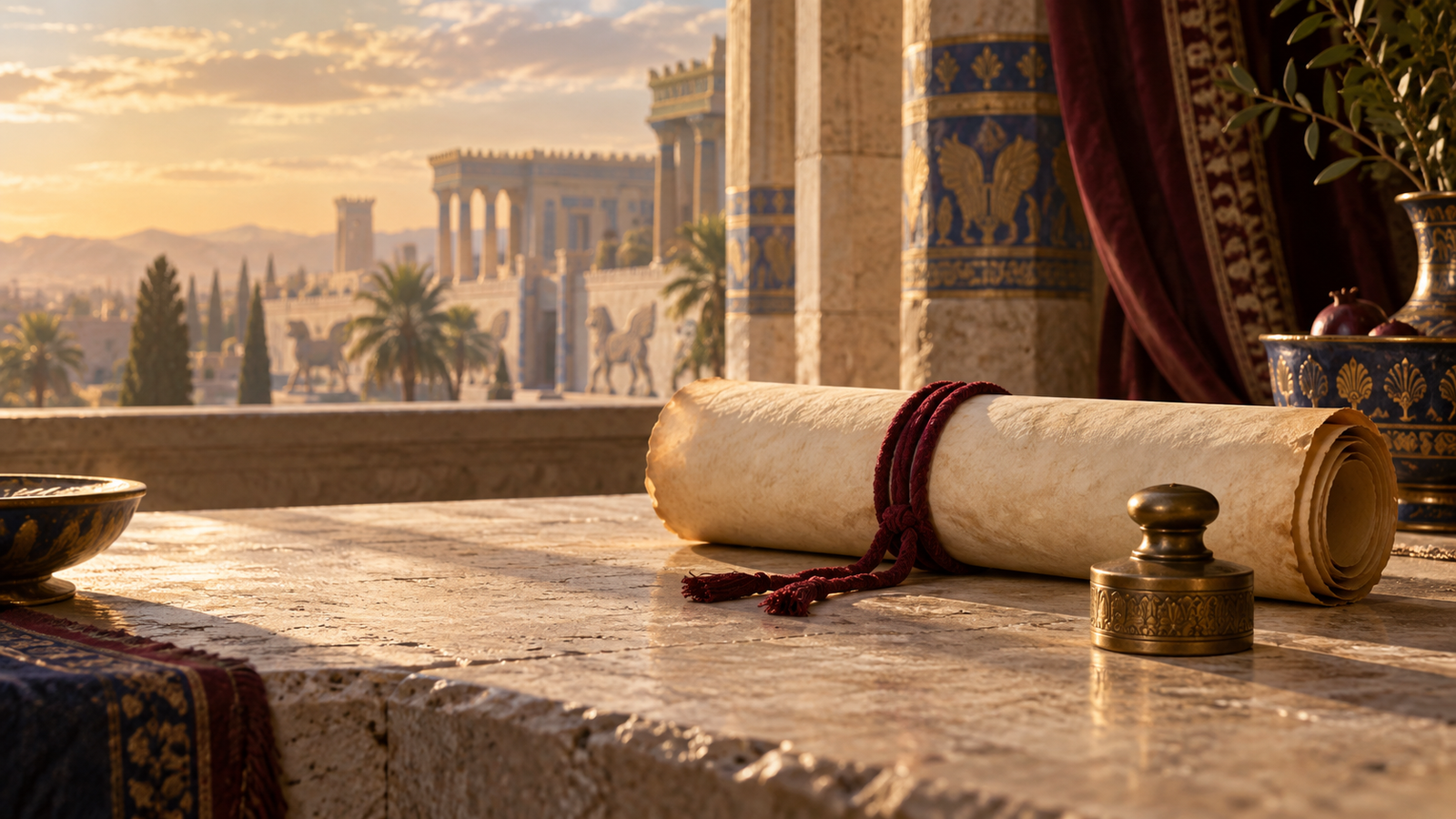
Purim is a Jewish observance that remembers the deliverance told in the Book of Esther. Its name comes from pur, the lot cast by Haman when he plotted the destruction of the Jewish people in the Persian Empire (Esther 3:7; 9:24–26).
Esther is a story of danger, courage, reversals, prayerful dependence, and the preservation of a people. God’s name is not explicitly written in the book, yet the story repeatedly invites readers to see His providence at work. A threatened people are not abandoned. A hidden queen is placed where she can act. A plot meant for death is overturned.
The story behind Purim
Esther lived among the Jewish exiles in the Persian Empire. The book identifies Mordecai as a Benjaminite and connects his household with the Jerusalem exile under King Jeconiah of Judah (Esther 2:5–6). This is not a story of the northern tribes’ Assyrian captivity. When King Xerxes chose a new queen, Esther’s Jewish identity was not initially known at court. Her cousin and guardian, Mordecai, refused to bow to Haman, a high official in the empire. Haman’s rage grew into a plan to destroy the Jewish people throughout the king’s provinces.
Esther faced a costly choice. To approach the king without being summoned could mean death. Mordecai urged her not to remain silent, saying, “Who knows if perhaps you have come to the kingdom for such a time as this?” (Esther 4:14, BSB). Esther called for a fast, approached the king, and exposed Haman’s plot. The decree could not simply be erased under Persian law, but a new decree enabled the Jews to defend themselves.
The book ends with a reversal: sorrow turns to joy, mourning turns to a holiday, and a threatened people are preserved (Esther 9:22).
What Esther 9 establishes
Mordecai recorded the events and sent letters establishing an annual remembrance on the fourteenth and fifteenth days of Adar. Esther 9:20–32 describes feasting and joy, sending gifts to one another, and gifts to the poor. It also records that the Jews bound themselves and their descendants to keep the remembrance at its appointed time.
The biblical book gives the historical foundation for the observance. Later Jewish tradition developed detailed practices for how it is kept in Jewish communities. Those later practices should be respected and identified as tradition; they should not be presented as commands found word-for-word in Esther.
Four central practices in Jewish tradition
- Hearing the Megillah. The Megillah is the Scroll of Esther. In many communities it is read in the evening and again the next day. Customs surrounding the reading, including making noise when Haman’s name is heard, vary by community.
- Mishloach manot. These are gifts of food sent to friends or neighbors. The phrase reflects Esther 9:22’s “sending gifts to one another.”
- Matanot la’evyonim. These are gifts to people in need. Esther 9:22 connects Purim’s joy with care for the poor.
- Seudat Purim. This is the festive Purim meal. Its foods and customs differ across Jewish communities and family histories.
These are Jewish practices. They are not a generic party template, and no one outside Jewish communal life should presume to set the rules for how Jewish people observe them.
Customs, food, and community variety
Purim is known for joyful public reading, charitable giving, food gifts, festive meals, costumes, plays, and humor. But Purim does not look identical everywhere. Ashkenazi, Sephardi, Mizrahi, Yemenite, Persian, and other Jewish communities have developed their own foods, music, languages, and local customs.
Hamantaschen—triangular filled pastries—are widely associated with Purim in Ashkenazi communities. They are not a biblical requirement, and they do not represent every Jewish community’s practice. Food can be a beautiful doorway into learning, but it should never replace listening to the people whose tradition is being discussed.
What Christians can learn from Esther
Christians should not turn Purim into a Christian holiday or treat Jewish practice as a costume. The first task is to listen to Esther as part of Israel’s Scriptures and to honor the Jewish people who have carried this remembrance across generations.
The book gives every reader much to consider. Courage is not the absence of danger. Faithfulness can require speaking when silence seems safer. Power can be used to preserve or to destroy. And God’s work is not absent simply because it is not obvious.
Esther also keeps us inside the larger biblical story. The God who preserved His people in Persia is the God who keeps His covenant promises. Jesus was born within that story: Israel’s Scriptures, Israel’s people, and Israel’s hope. Christians do not need to claim Purim as their own in order to receive Esther’s witness with gratitude and humility.
A respectful way to learn
Read Esther in full. Notice the risks Esther and Mordecai face, the way the story turns, and the care given to the poor in the book’s final description of Purim. If you are invited into a Jewish community’s public Purim event, receive that invitation as a guest: learn, ask thoughtful questions, and follow the host community’s guidance.
The point is not to imitate a tradition from a distance. It is to understand the biblical story more truthfully and to honor the living Jewish world connected with it.
Find the Way—Meet Rabbi Jesus.
Further study
- Esther 1–10; especially Esther 4:14 and 9:20–32. Scripture quotations are from the Holy Bible, Berean Standard Bible (BSB), third printing.
- My Jewish Learning, “The Four Mitzvot of Purim.”
- Chabad.org, “Halachot U’minhagim — Laws and Customs of Purim.”
- Sefaria, Esther 9:20–32.