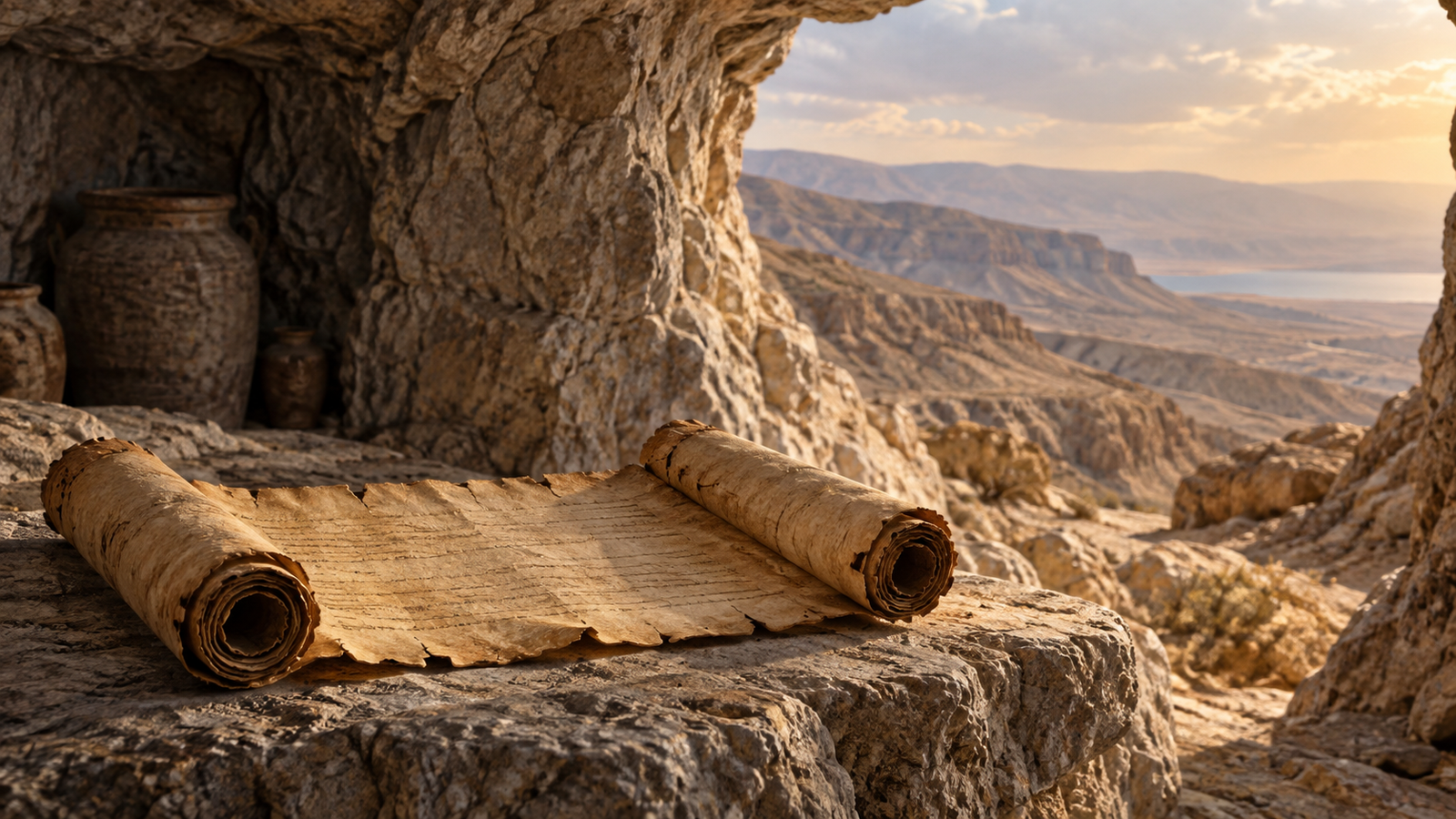
The Dead Sea Scrolls are ancient Jewish manuscripts discovered in caves near Qumran, on the northwest shore of the Dead Sea, beginning in 1947. They include copies of biblical books, prayers, commentaries, community rules, legal writings, and other Jewish works from the Second Temple period.
They matter because they let us read Jewish texts from the centuries before and during the time of Jesus. The scrolls do not replace Scripture. They help us see the Jewish world in which Scripture was copied, studied, prayed, and debated.
A discovery in the Judean Desert
In 1947, Bedouin of the Ta’amireh tribe found the first scrolls in what became known as Cave 1 near Khirbet Qumran. Over the next several years, Bedouin searchers and archaeologists found manuscripts and fragments in eleven nearby caves. The Qumran discoveries represent more than 900 manuscripts, most of them preserved only in fragments.
The phrase “Dead Sea Scrolls” is also used more broadly for Jewish manuscripts found elsewhere in the Judean Desert. That wider collection includes material from places such as Wadi Murabba’at, Nahal Hever, and Masada. This article focuses mainly on the manuscripts from the Qumran caves, because those are the scrolls most people mean by the name.
How old are they?
The Qumran manuscripts were copied roughly from the third century BC to the first century AD. Scholars use handwriting analysis, radiocarbon testing, archaeology, and the manuscripts’ own contents to estimate dates.
The Great Isaiah Scroll is among the best-known examples. Copied around 125 BC, it contains all sixty-six chapters of Isaiah in Hebrew. It is more than a thousand years older than the complete medieval Hebrew Bible manuscripts that had been available before the scrolls were found.
What is in the scrolls?
The manuscripts are written mainly in Hebrew, with some Aramaic and a small amount of Greek. Most are written on parchment; some are on papyrus. The Copper Scroll is the unusual exception: its text was written on copper sheets.
- Biblical manuscripts. Copies of books that belong to the Hebrew Bible, including Isaiah, Psalms, Deuteronomy, Samuel, and the Twelve Prophets.
- Jewish writings beyond the biblical books. Works such as Jubilees and the Genesis Apocryphon show how some Jewish readers retold and explored the biblical story.
- Rules and instruction. The Community Rule describes the commitments and practices of a disciplined religious group.
- Commentary and prayer. The Pesher on Habakkuk, thanksgiving hymns, and other writings show Scripture being interpreted and prayed within a particular Jewish community.
Do the scrolls prove that every copy of the Bible was identical?
No. They show both continuity and variety.
Many scroll passages are close to the later Masoretic Text, the traditional Hebrew text behind many modern Old Testament translations. At the same time, some manuscripts preserve different spellings, wording, arrangements, or readings. The Great Isaiah Scroll, for example, is broadly close to the Masoretic form of Isaiah while also containing many variants.
That is not a reason for panic. It is evidence that the Hebrew Scriptures were copied, read, and transmitted within a living Jewish world. Textual scholars compare these witnesses carefully. Their work helps readers see where the evidence is strong, where a reading is disputed, and why translation notes sometimes differ.
Who wrote them?
We do not know that every Qumran manuscript came from one group. The ruins at Qumran and writings such as the Community Rule have led many scholars to connect at least some texts with a separatist Jewish community, often compared with the Essenes described by ancient writers. That proposal remains debated.
The careful conclusion is simpler: the manuscripts give us direct access to several streams of Jewish life in the Second Temple period. They should not be made to speak for all Jewish people, and the community behind some texts should not be treated as identical with the Pharisees, later rabbinic Judaism, or the first followers of Jesus.
What do they tell us about Jesus and the New Testament?
The Dead Sea Scrolls are Jewish documents, not Christian documents. They do not mention Jesus, the apostles, or the early church.
They do show the world in which Jesus lived: a Jewish world shaped by Scripture, hopes for God’s redemption, debates about holiness, prayer, Temple life, ritual washing, and the coming kingdom. Some scrolls speak of messianic expectation, final judgment, light and darkness, and close reading of the prophets. Those themes can also appear in the New Testament because both arise from the Scriptures and Jewish life of the period.
Shared language or a similar practice does not prove direct borrowing. The Teacher of Righteousness in some Qumran texts is not Jesus, and the Qumran community should not be used as a shortcut for explaining the first Jesus movement. The better approach is to let each text speak in its own setting and then compare carefully.
Why the scrolls still matter
The Dead Sea Scrolls give us an extraordinary window into the Jewish world before AD 70. They show that Jewish readers treasured Scripture, copied it carefully, interpreted it intensely, and hoped for God to act decisively in history.
For followers of Jesus, the scrolls sharpen an important reminder: the New Testament did not appear in a vacuum. Jesus, His disciples, and the earliest believers lived in Israel’s story, read Israel’s Scriptures, and spoke within the varied Jewish world of their day.
Timeline
| Date | What happened |
|---|---|
| c. 250–100 BC | Many of the earliest Qumran manuscripts were copied. |
| c. 125 BC | The Great Isaiah Scroll was copied. |
| c. AD 1–68 | The latest Qumran manuscripts belong to the final decades before the Roman destruction of the site. |
| AD 70 | Rome destroyed the Second Temple in Jerusalem. |
| AD 1947–1956 | The Qumran-cave manuscripts were discovered and recovered. |
Further study
- Israel Antiquities Authority, The Dead Sea Scrolls: Discovery and Publication and Introduction.
- Israel Museum, Jerusalem, The Great Isaiah Scroll.
- 1QS, Community Rule; 1QpHab, Pesher on Habakkuk; 1QIsaᵃ, Great Isaiah Scroll.
- Emanuel Tov, Textual Criticism of the Hebrew Bible.
- John J. Collins, Beyond the Qumran Community.
- Lawrence H. Schiffman, Reclaiming the Dead Sea Scrolls.
Find the Way—Meet Rabbi Jesus.