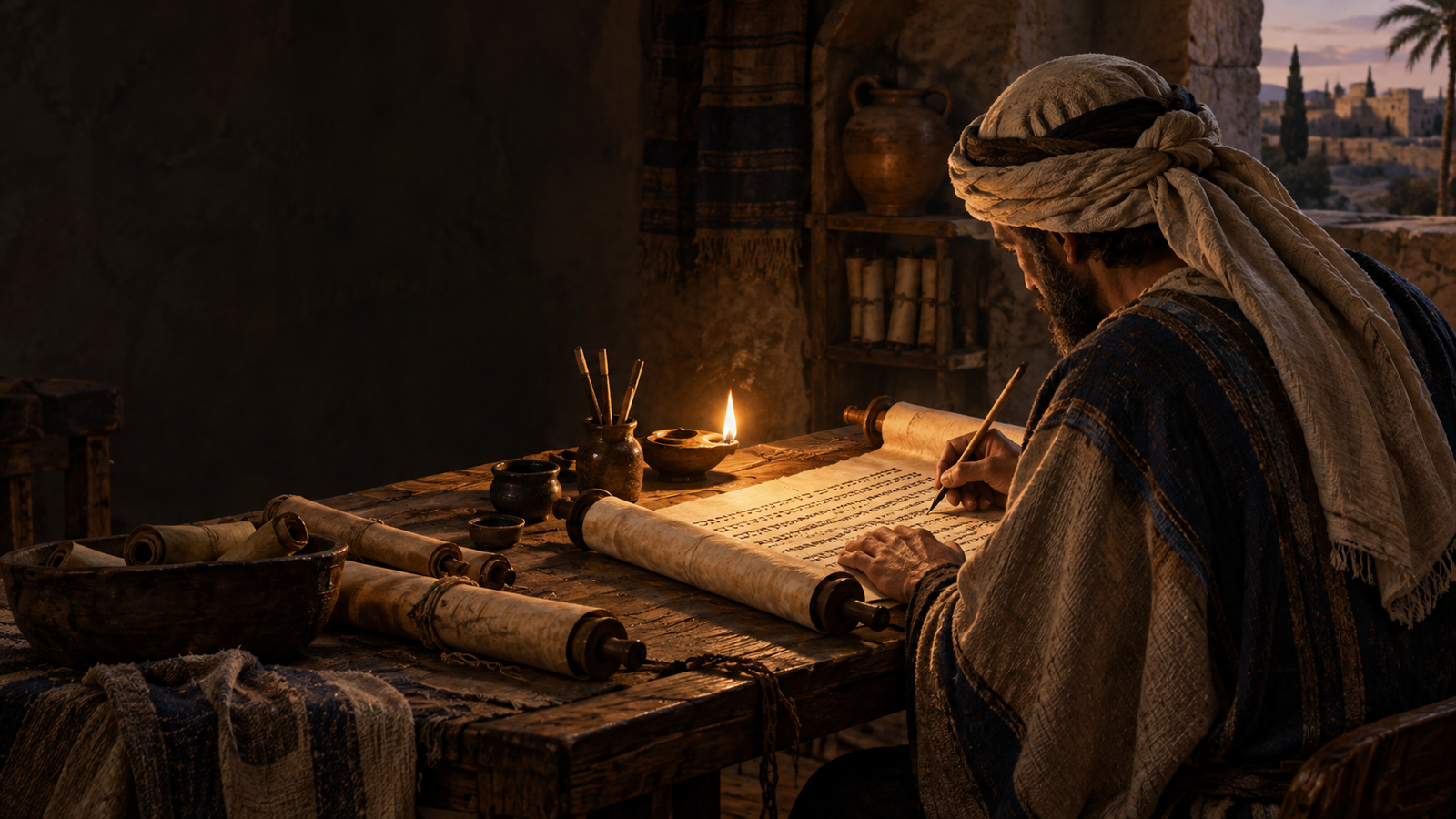
The Bible is not one book written in one sitting by one human author. It is a library: law, narrative, poetry, prophecy, wisdom, Gospels, letters, and apocalypse. Its books arose across many centuries in Hebrew, Aramaic, and Greek. They were written, collected, copied, preserved, and recognized among the people of God.
That does not make the Bible less trustworthy. It tells us what kind of book it is. God gave His word in real history, through real people, in particular languages and communities.
Start with what the Bible itself says
The Bible does not give us a single table of authors for every book. Some books name a writer. Some name a prophet, king, priest, scribe, or messenger. Some speak in an anonymous voice. Some show signs that earlier records, songs, laws, or eyewitness testimony were gathered into a finished work.
- Exodus says that Moses wrote down the words of the covenant (Exodus 24:4).
- Deuteronomy says that Moses wrote down “this law” and gave it to the priests and elders (Deuteronomy 31:9, 24–26).
- Several psalms carry Davidic headings, while others are connected with Asaph, the sons of Korah, Solomon, Moses, and others.
- Luke explains that he investigated the events concerning Jesus carefully and wrote an orderly account (Luke 1:1–4).
- Paul identifies himself at the opening of many letters, while also using co-workers and, at times, a secretary to assist with the writing.
Those statements matter. But they do not settle every modern question about every book’s final form. A faithful answer should not force more certainty than the evidence gives.
The Torah: Moses and the books of Moses
For Jews and Christians, the first five books—Genesis, Exodus, Leviticus, Numbers, and Deuteronomy—have long been called the Torah or the Books of Moses. Later biblical books repeatedly speak of “the Law of Moses.” Jesus also speaks of Moses in connection with the Law.
The traditional conservative position is that Moses is the foundational human author and covenant mediator behind the Torah. The text itself connects him directly to written laws and covenant words. At the same time, the Torah’s finished form includes material that naturally raises questions about preservation and editorial care—most plainly, the account of Moses’ death in Deuteronomy 34.
A conservative account can affirm Moses’ central authorship while recognizing that a completed Torah was carefully preserved and may include limited inspired editorial work after his death. Modern scholars debate the extent of sources, stages of composition, and editing within the Pentateuch. Those debates are reconstructions; they are not themselves Scripture.
Israel’s poets, sages, and prophets
The Hebrew Bible preserves many voices. David is closely associated with Israel’s worship and with many psalms, but the Psalter also preserves songs from other writers and anonymous worshipers. Solomon is traditionally associated with Proverbs, Ecclesiastes, and the Song of Songs, while Proverbs itself includes material connected with other sages.
The prophetic books identify Isaiah, Jeremiah, Ezekiel, Hosea, Amos, and many others as God’s messengers. Jeremiah explicitly names Baruch as the scribe who wrote down Jeremiah’s words (Jeremiah 36:4). Some books leave the human writer unnamed. Anonymity is not a defect; it is a reason to read the work for what it says rather than pretend we know more than we do.
The Gospels: four witnesses to one Jesus
The four Gospels are anonymous within their own opening lines. Their familiar names—Matthew, Mark, Luke, and John—come from the early church’s received testimony. That testimony should be taken seriously, but it should also be described accurately: it is early Christian witness about the Gospels, not a signed title page in the original text.
The ancient tradition connects Matthew with the apostle, Mark with Peter’s preaching, Luke with Paul’s co-worker, and John with the beloved disciple and apostolic circle. Luke’s prologue confirms a careful historical purpose. The Gospels give four faithful portraits, each selecting and arranging material to proclaim the same Jesus: Israel’s Messiah, the crucified and risen Lord, and the One who brings God’s kingdom near.
The letters and Revelation
Paul’s letters are the clearest examples of named New Testament authorship. Romans begins, “Paul, a servant of Christ Jesus, called to be an apostle” (Romans 1:1). The New Testament also contains letters associated with James, Peter, John, and Jude. Hebrews is anonymous. Revelation identifies its writer simply as John. Christians have long debated whether that John is the apostle John or another early Christian prophet.
What Christians mean by inspiration
Christians do not mean that God erased human personality and turned writers into machines. The Bible’s authors write in different styles, genres, settings, and languages. Yet Scripture says that “all Scripture is God-breathed” (2 Timothy 3:16). Peter describes prophecy as people speaking from God while carried along by the Holy Spirit (2 Peter 1:21).
Why this leads us to Jesus
Jesus did not treat Israel’s Scriptures as a loose collection of religious opinions. He spoke of Moses, the Prophets, and the Psalms, and He taught that they point toward God’s saving purpose fulfilled in Him (Luke 24:27, 44).
So the best answer is both simple and careful: the Bible was written by many human authors, scribes, and witnesses across centuries; God is its ultimate author. The human history is real. The divine message is not less real because it came through history. In that message, the whole biblical story leads us to Israel’s Messiah, Rabbi Jesus.
Find the Way—Meet Rabbi Jesus.
Further study
- The Bible passages named throughout this article, quoted from the Holy Bible, Berean Standard Bible (BSB), third printing.
- Richard E. Averbeck, “Torah and Treaty,” in Biblical and Ancient Near Eastern Law.
- D. A. Carson and Douglas J. Moo, An Introduction to the New Testament.
- Craig L. Blomberg, The Historical Reliability of the Gospels.