
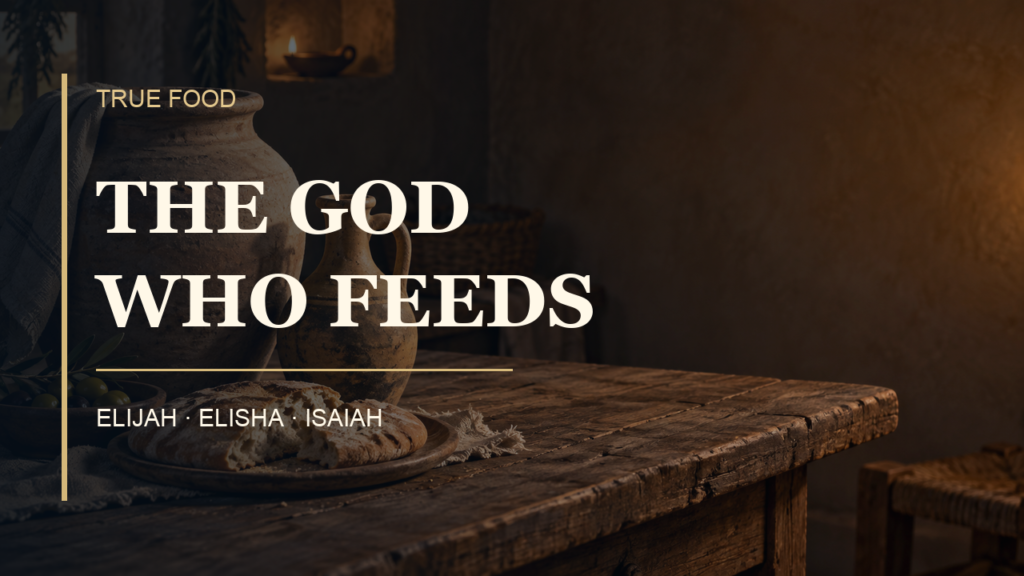
God provides food. The people He feeds can still face grief.
Click to listen: The God Who Feeds: Elijah, Elisha, and Isaiah | True Food
Download the reading companion (PDF)
God provides. Grief is still real.
What does it mean to call God the giver of life when the people He feeds can still suffer? This True Food teaching follows actual meals, vulnerable households, exhausted servants, and a prophetic feast. We invite you to keep the biblical passages open as you listen. The stories ask us to hold real provision and real suffering together.
Elijah: food, dependence, and prayer
Read 1 Kings 17–19 alongside Deuteronomy 11:13–17. In drought, Elijah receives food through ravens and then through a widow’s household. The account moves from daily provision into the death of her son and Elijah’s prayer. Later, an exhausted Elijah receives food and rest. These are particular acts of God’s care within particular stories. They do not make hunger or grief imaginary, and they do not promise that faithful people will never face either.
Elisha: a household, a pot, and barley loaves
Read 2 Kings 4 in its own sequence. The chapter brings together a widow’s oil, hospitality and grief in another household, a dangerous pot of food, and the feeding of one hundred people with twenty barley loaves. Notice who is in need, what is available, what the prophet says, and what happens. Keep the people and quantities distinct rather than flattening these accounts into one repeated miracle.
The Psalms and Isaiah widen the horizon
Read Psalms 36, 107, and 145, then Isaiah 25 and 55. The Psalms direct our attention to the Lord as the giver and sustainer of life. Isaiah’s feast for all peoples and invitation to the thirsty widen the question beyond a single household or meal. Isaiah 25 also speaks of the defeat of death. This is a canonical connection in our reading; it is not a claim that the Psalms were composed after Elijah.
The question that leads toward Jesus
The teaching closes by looking toward the Gospel feeding accounts, including Mark 6:37 and John 6:8–9. Shared features invite careful attention, while the accounts retain their own settings and quantities. As you read, ask what each passage actually says about the Lord’s provision and the people receiving it. Our next step is to follow the question toward Jesus without rushing past the suffering already present in these texts.
Read and reflect
1. Where does each story place need, dependence, prayer, and provision? 2. What changes when Isaiah places food beside the defeat of death? 3. How can we speak honestly about God’s care without promising that every present hardship will disappear? Read the surrounding chapters as well as the selected verses, and bring your observations into our Scripture conversation.
Sources and presentation
Scripture readings use the Berean Standard Bible, third printing, whose text is dedicated to the public domain. Research consulted: Paul R. House, 1, 2 Kings (New American Commentary); Gary V. Smith, Isaiah 1–39 and Isaiah 40–66 (New American Commentary); and Ugaritic Narrative Poetry, edited by Simon B. Parker (1997), for limited historical context about storm and rain imagery. The comparison is not proof of biblical borrowing or that Elijah knew a particular tablet. The program uses an authorized AI-generated version of Roger Ferguson’s voice and imaginative illustrative artwork.
All teaching remains free. Optional support.
Find the Way—Meet Rabbi Jesus.
Walk the Way — Modern Mind, Ancient Book.