Roger F

The LORD Dwells in Zion | Joel 3:1–21

How can God’s judgment be hope for people who have been harmed? Joel’s final chapter brings wrongs into the light, calls the nations to account, and ends with the LORD dwelling among His people. The Judge is also their refuge. We invite you to read Joel 3:1-21 slowly before watching our closing study of the book. Notice who speaks, what wrongs are named, and who finally acts. The passage does not ask wounded people to pretend that evil does not matter. It also does not hand us permission to take divine vengeance into our own hands. Wrongs are remembered Joel names the scattering of God’s people, the dividing of the land, plunder, and the sale of human beings. The language gives suffering moral weight. People are not disposable, and power does not make their mistreatment invisible to God. The named peoples illuminate these wrongs, although the precise historical incidents and the book’s composition date remain uncertain. The chapter also contains troubling words about the perpetrators’ children being sold. We keep that difficulty visible. Commentators differ over how literally to read this judicial reversal. It offers no authorization for slavery, ethnic retaliation, or private revenge today. The verdict belongs to the LORD The valley of decision is the setting of the LORD’s verdict. It is not a scene in which the crowds make a modern altar-call decision. Neither the Valley of Jehoshaphat nor the Valley of Acacias can be placed on a map with certainty. Similar prophetic images do not establish a detailed end-time timetable. This distinction matters for our response. We can name injustice, protect the vulnerable, and resist the temptation to make ourselves the final judge. Read Romans 12:14-21 alongside Joel: the wider biblical conversation keeps divine judgment from becoming a warrant for personal retaliation. The final word is presence Joel’s picture moves toward renewed land, a spring from the LORD’s house, and His dwelling in Zion. The hope is more than a change of circumstances: God will be present with His people. As you read, follow the movement from what has been done to them toward who will be with them. The holy-city boundary in Joel is real, and commentators differ about its restrictiveness. We follow the inclusion of faithful people from the nations through Israel’s Messiah in the wider canon, rather than changing Joel’s words. Read Ephesians 2 and Revelation 21-22 as conversation partners, keeping each passage in its own setting. Read and reflect with us Begin with Joel 3:1-21. Then read Romans 12:14-21, Ephesians 2, and Revelation 21:1-22:5. Where does the text name harm? What belongs to the LORD alone? How does His promised presence shape the hope of the chapter? Bring those observations to the complete teaching. A final reading note: Joel 3:21 has a genuine textual difficulty. Cleansing or acquittal and avenging appear in the Hebrew and ancient-version discussion. Our teaching retains the Berean Standard Bible’s avenging wording when quoting it, without treating that wording as the only undisputed rendering. Watch the complete teaching Click to listen: The LORD Dwells in Zion | Joel 3:1–21 Sources and further study Scripture: Joel 3:1-21 and the comparative passages above. Scripture quotations in the teaching use the Holy Bible, Berean Standard Bible, third printing (public domain). This companion paraphrases the passage; it is not a replacement for reading Scripture. Duane A. Garrett, Hosea, Joel, New American Commentary 19A (Broadman & Holman, 1997), Joel 3:1-21; James L. Crenshaw, Joel: A New Translation with Introduction and Commentary, Anchor Bible 24C (Doubleday, 1995; Yale University Press edition, 2008), Hebrew Joel 4:1-21 / English Joel 3:1-21. These sources help distinguish the text’s claims from uncertain geography, dating, and interpretive alternatives. All teaching remains free. Voluntary support: https://ko-fi.com/modernmindancientbook Download this reading companion (PDF)
The LORD Dwells in Zion | Joel 3:1–21 Read More »

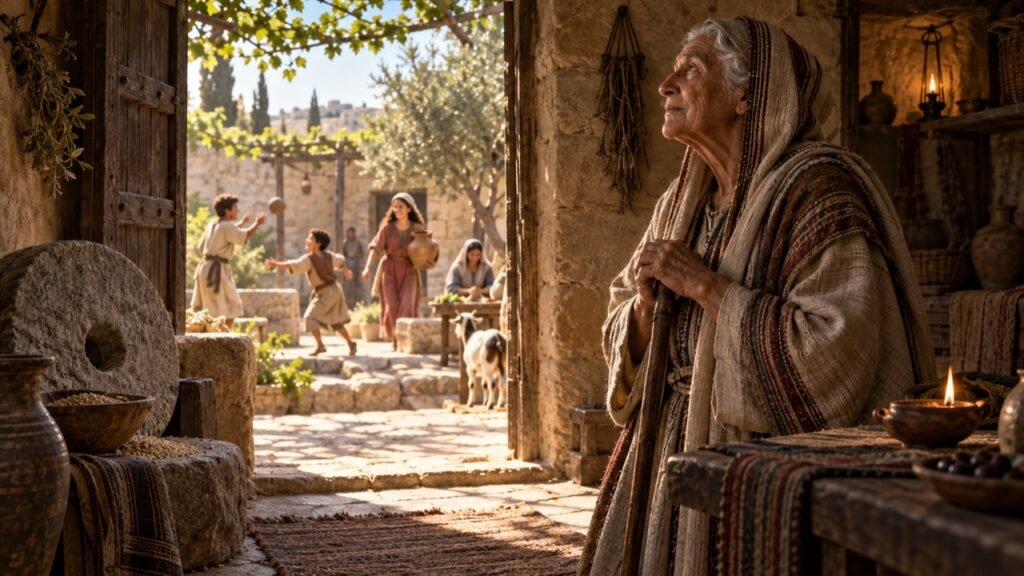
Illustrative artwork of an older woman in a warm stone home looking toward a sunlit courtyard where children and adults share ordinary life.

How Do We Live When Death Comes to Everyone?

Click to listen: How Do We Live When Death Comes to Everyone? | Ecclesiastes 9–12 Download the reading companion (PDF) We cannot control what tomorrow will bring, but Ecclesiastes still gives you and us a faithful way to live today. The closing chapters of Ecclesiastes do not offer easy answers. Death comes to everyone. Skill does not guarantee success. Wisdom may be ignored or forgotten. Foolishness can gain power. Age steadily narrows our strength. The Teacher lets these realities remain difficult because faithful living begins with truth, not denial. Yet this is not a lesson in giving up. Ecclesiastes 9-12 repeatedly calls us back into life. Receive the gifts in front of you Ecclesiastes tells us to eat with joy, receive the companionship God gives, and work wholeheartedly while we have the opportunity. These ordinary gifts are not distractions from a serious life. They are part of the life God has given us to receive. That matters because fear can make us postpone living. We tell ourselves that we will act when the outcome is secure, love when the risk is gone, or give thanks when every uncertainty has been resolved. Ecclesiastes will not let us wait for a control we were never promised. Act faithfully without guarantees The swift do not always win the race, the strong do not always win the battle, and the wise are not always rewarded as they deserve. Ecclesiastes is honest about the limits of skill and planning. But uncertainty is not permission to become passive. The Teacher still tells us to sow, to give, to work, and to act. Faithfulness is not a technique for forcing a result. It is the right response to God even when the result remains beyond us. This is one of the book’s most practical gifts: you do not need complete knowledge of tomorrow before taking the next faithful step today. Resist the quiet spread of folly Ecclesiastes also shows how a little folly can outweigh much wisdom. Careless speech, poor leadership, laziness, and unmanaged desire can damage more than we expect. Wisdom does not make us sovereign over life, but it still helps us walk through life with greater honesty and care. The question is not whether wisdom can remove every risk. It cannot. The question is whether we will listen to wisdom when noise, power, or immediate appetite seems more impressive. Remember your Creator The final movement turns toward youth, aging, and remembrance. Remember your Creator is not a gloomy command to stop enjoying life. It is an invitation to live our years in their proper relationship to the One who gave them. The poem of aging in Ecclesiastes 12 is tender and unsparing. Strength fades. Familiar abilities narrow. The body returns to dust. Remembering our Creator now keeps us from treating life as though it belongs entirely to us. Live in light of judgment and hope Ecclesiastes closes by calling us to fear God, keep His commandments, and remember that every deed comes into judgment. The book itself ends with accountability before God; it does not fully unfold the later biblical teaching about resurrection. When we read within the wider canon, Jesus’ words at Lazarus’s tomb and Paul’s teaching in 1 Corinthians 15 bring resurrection hope into view. We should keep those settings distinct. Ecclesiastes teaches us to live faithfully within mortal limits. The New Testament announces that death will not have the final word because of Jesus. Read it for yourself As you read Ecclesiastes 9:1-12:14, notice every place the Teacher tells us to act even though we cannot know the outcome: Ecclesiastes 9:1-10 – receive life’s gifts and do the work before you. Ecclesiastes 9:11-18 – skill matters, but it cannot guarantee recognition or success. Ecclesiastes 10 – resist folly in speech, work, and leadership. Ecclesiastes 11 – give, sow, and act without demanding certainty. Ecclesiastes 12 – remember your Creator and live accountable to Him. Where are you tempted to postpone faithful action until you have certainty God never promised? Click to listen: How Do We Live When Death Comes to Everyone? | Ecclesiastes 9–12 Reading notes and qualifications The dead know nothing. This concerns ended participation in the observed life under the sun. It is not used here as a complete doctrine of resurrection or the intermediate state. God has already approved your works. Ecclesiastes 9:7 commends the ordinary enjoyments named in 9:7-10. It is not universal approval of every action or a doctrine of merit. Time and chance. The phrase names the unpredictability of outcomes from the human vantage point. It does not remove the Creator, providence, or judgment from the book. The poor wise man. He most likely rescued the city, but the text does not tell us how. We do not invent the missing civic details. Bread on the waters and seven or eight portions. These sayings have credible generosity, commerce, and risk-distribution readings. Their secure ethical center is diligent and openhanded action under uncertainty, not a guaranteed return. The aging poem. Its images are not treated as a rigid anatomical code. They honor the seriousness of declining capacity and death without reducing older people to decline. One Shepherd. Several responsible interpretations remain possible. We preserve the phrase and its authority claim without forcing it into a direct prediction of Jesus. Fear God and obey. Fear of God and obedience are inseparable in the epilogue, but obedience is not presented as a purchase price for salvation. Scripture and sources Unless otherwise noted, Scripture quotations are from the Holy Bible, Berean Standard Bible (BSB), third printing. The BSB text is dedicated to the public domain. berean.bible Primary passage: Ecclesiastes 9:1-12:14. Canonical conversation: Genesis 2:7; Genesis 3:19; Deuteronomy 6:1-9; Deuteronomy 17:14-20; Psalm 90:1-17; Proverbs 1:1-7; Daniel 7:13-14; Matthew 20:25-28; John 5:24-29; John 11:17-27; 1 Corinthians 1:18-31; 1 Corinthians 15:12-58; Hebrews 9:27-28; Revelation 20:11-15. Garrett, Duane A. Proverbs, Ecclesiastes, Song of Songs. New American Commentary 14. Nashville: Broadman & Holman, 1993. Ecclesiastes 8:9-12:14. Ogden, Graham S., and Lynell Zogbo. A

How Do We Live When Death Comes to Everyone? Read More »

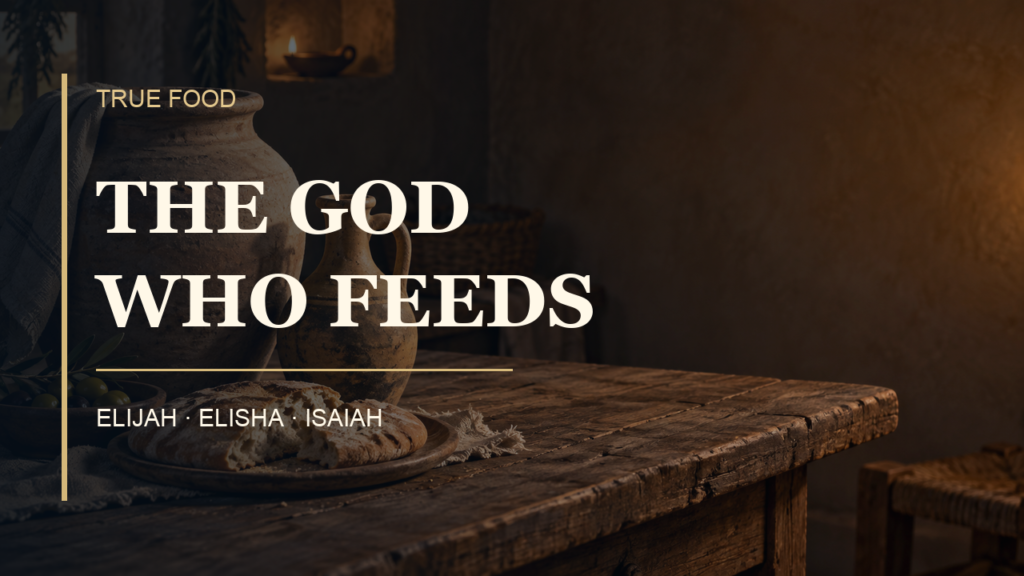
Illustrative artwork of bread and clay vessels on a table. Text: True Food; The God Who Feeds; Elijah, Elisha, Isaiah.

The God Who Feeds: Elijah, Elisha, and Isaiah

God provides food. The people He feeds can still face grief. Click to listen: The God Who Feeds: Elijah, Elisha, and Isaiah | True Food Download the reading companion (PDF) God provides. Grief is still real. What does it mean to call God the giver of life when the people He feeds can still suffer? This True Food teaching follows actual meals, vulnerable households, exhausted servants, and a prophetic feast. We invite you to keep the biblical passages open as you listen. The stories ask us to hold real provision and real suffering together. Elijah: food, dependence, and prayer Read 1 Kings 17–19 alongside Deuteronomy 11:13–17. In drought, Elijah receives food through ravens and then through a widow’s household. The account moves from daily provision into the death of her son and Elijah’s prayer. Later, an exhausted Elijah receives food and rest. These are particular acts of God’s care within particular stories. They do not make hunger or grief imaginary, and they do not promise that faithful people will never face either. Elisha: a household, a pot, and barley loaves Read 2 Kings 4 in its own sequence. The chapter brings together a widow’s oil, hospitality and grief in another household, a dangerous pot of food, and the feeding of one hundred people with twenty barley loaves. Notice who is in need, what is available, what the prophet says, and what happens. Keep the people and quantities distinct rather than flattening these accounts into one repeated miracle. The Psalms and Isaiah widen the horizon Read Psalms 36, 107, and 145, then Isaiah 25 and 55. The Psalms direct our attention to the Lord as the giver and sustainer of life. Isaiah’s feast for all peoples and invitation to the thirsty widen the question beyond a single household or meal. Isaiah 25 also speaks of the defeat of death. This is a canonical connection in our reading; it is not a claim that the Psalms were composed after Elijah. The question that leads toward Jesus The teaching closes by looking toward the Gospel feeding accounts, including Mark 6:37 and John 6:8–9. Shared features invite careful attention, while the accounts retain their own settings and quantities. As you read, ask what each passage actually says about the Lord’s provision and the people receiving it. Our next step is to follow the question toward Jesus without rushing past the suffering already present in these texts. Read and reflect 1. Where does each story place need, dependence, prayer, and provision? 2. What changes when Isaiah places food beside the defeat of death? 3. How can we speak honestly about God’s care without promising that every present hardship will disappear? Read the surrounding chapters as well as the selected verses, and bring your observations into our Scripture conversation. Sources and presentation Scripture readings use the Berean Standard Bible, third printing, whose text is dedicated to the public domain. Research consulted: Paul R. House, 1, 2 Kings (New American Commentary); Gary V. Smith, Isaiah 1–39 and Isaiah 40–66 (New American Commentary); and Ugaritic Narrative Poetry, edited by Simon B. Parker (1997), for limited historical context about storm and rain imagery. The comparison is not proof of biblical borrowing or that Elijah knew a particular tablet. The program uses an authorized AI-generated version of Roger Ferguson’s voice and imaginative illustrative artwork. All teaching remains free. Optional support. Find the Way—Meet Rabbi Jesus.Walk the Way — Modern Mind, Ancient Book.

The God Who Feeds: Elijah, Elisha, and Isaiah Read More »

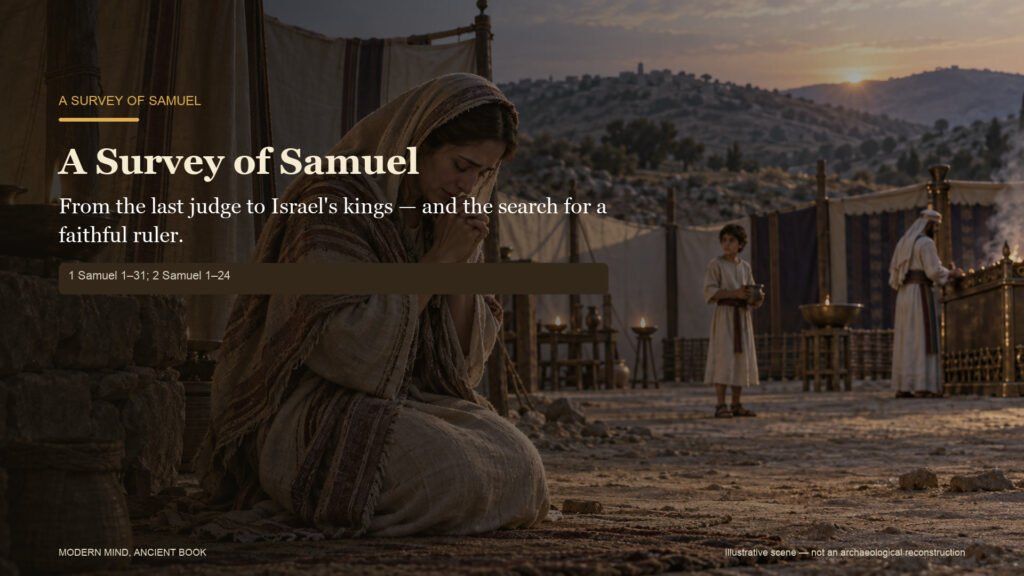
Illustrative artwork of a woman praying and a boy near an ancient shrine at sunset. Text: A Survey of Samuel; From the last judge to Israel’s kings—and the search for a faithful ruler.

Samuel Explained: Kingship, Covenant, and the Heart God Seeks

Israel wanted a king. Power alone could not make a faithful one. Click to listen: Samuel Explained: Kingship, Covenant, and the Heart God Seeks Download the reading companion (PDF) Power and the heart Israel wanted a king. Power alone could not make a faithful one. The books of Samuel follow Israel from the leadership of judges into the reigns of Saul and David. Along the way, public strength and private faithfulness do not always travel together. This reading companion helps you follow the main movements of our 16-minute teaching. Begin with a prayer, not a throne Read 1 Samuel 1-3. The story opens with Hannah and the birth and calling of Samuel. Before you reach the kings and battles, notice the people who pray, listen, and respond. This beginning gives you a different starting point for thinking about leadership. What did Israel expect from a king? Read 1 Samuel 8. Israel asks for a king like the surrounding nations. Samuel warns about what royal power can take from the people. As you read, ask what the people hope a king will provide, and what they are willing to overlook to gain it. Look beyond the appearance of strength Read 1 Samuel 16-17 and 24. David is anointed, faces Goliath, and later has an opportunity to kill Saul. These scenes invite you to watch how courage and restraint appear in the same life. What does David do when he has the power to act? A promise does not hide a failure Read 2 Samuel 7 and 11-12. God makes a promise concerning David and his house. Later, the account of Bathsheba, Uriah, and Nathan confronts David with the harm he has done. Read both passages carefully. The story preserves the promise while also naming the king’s wrongdoing and its consequences. Read, listen, and reflect Our teaching follows Samuel, Saul, and David through kingship, covenant, and the heart God seeks. As you listen, keep one question nearby: where does the story show the difference between having power and using it faithfully? Return to one of the passages above and compare your observations with the teaching. Source notes Source and reading notes: Primary texts are 1 Samuel 1-31 and 2 Samuel 1-24. This companion summarizes the biblical narrative; it contains no direct Scripture quotations. The episode’s comments on authorship, dating, composition, and audience are MMAB historical interpretation. Its illustrations are meaning-led artwork, not archaeological evidence or portraits of known individuals. Preserved archival speech is not relabeled as a new verbatim Berean Standard Bible reading. All teaching remains free. Voluntary support

Samuel Explained: Kingship, Covenant, and the Heart God Seeks Read More »

I Will Pour Out My Spirit | Joel 2:18–32

I Will Pour Out My Spirit Joel 2:18-32: from a devastated land to the gift of the Spirit What do we hear when God promises restoration? We may immediately think about what we have lost and when it will be returned. Joel asks us first to look at the land, the people and the God who is present among them. The gifts lead us toward knowing the Giver. Hear the restoration promise in its setting Joel 2:18-27 speaks into the devastation of a community and its land. Provision touches ordinary life: grain, wine, oil, rain and the work of living. The movement leads toward satisfaction, praise and the recognition that the LORD is among His people. We invite you to keep that first audience in view. Covenant restoration is not a guarantee that every personal loss will be repaid on our timetable. We can receive the passage with gratitude without making a promise it does not make to every individual circumstance. The promise widens to sons and daughters In Joel 2:28-32, the promise reaches the outpouring of God’s Spirit, prophetic speech, dreams and visions, the Day of the LORD, and deliverance. Sons and daughters, old and young, appear within this promise. Read the whole movement rather than detaching one familiar line from its setting. Our study brings Numbers 11:24-30 into the conversation before following Peter into Acts 2:14-41. Peter connects Joel’s words with the gift of the Spirit and the risen Jesus at Pentecost. The promise leads us toward the Messiah and an invitation to call upon the LORD. Follow the promise without flattening it We understand Pentecost as the inauguration of Joel’s promised messianic age, without treating it as the exhaustion of every remaining Day-of-the-LORD detail. Acts 2 quotes Joel 2:28-32a; it does not quote the remainder about Zion, Jerusalem and the remnant. The welcome of the nations does not erase Israel. Romans 10:5-17, read within Romans 9-11, adds another important part of the reading path. We are invited to hear, believe, call upon the Lord and receive His welcome. Gratitude for His gifts can become a deeper desire to know Him. Read and reflect with us Begin with Joel 2:18-32. Then read Numbers 11:24-30, Acts 2:14-41 and Romans 10:5-17 within Romans 9-11. For further comparison, read Deuteronomy 8:10-18; Isaiah 44:1-5; Ezekiel 36:22-32 and 39:25-29. What stands out when you hear the restoration promise alongside Peter’s words in Acts 2? Click to listen: I Will Pour Out My Spirit | Joel 2:18–32 Source notes and important distinctions This article accompanies the approved MMAB study and preserves its interpretation and limits. The episode consults Duane A. Garrett, Hosea, Joel, New American Commentary 19A (1997), Joel 2:18-32 and New Testament interpretation excursus; James L. Crenshaw, Joel, Anchor Bible 24C (1995; Yale impression 2008), “Replacing What Locusts Consumed” and “Signs and Portents”; HALOT entries behind Joel 2:23; NET Bible First Edition Notes, Joel 2:18-32; John B. Polhill, Acts, NAC 26 (1992), Acts 2:14-41; and Colin G. Kruse, Paul’s Letter to the Romans (2012), Romans 10:5-21. Garrett and Crenshaw differ on whether the northern force is a human enemy or locusts. The rain/teacher wording in Joel 2:23 also has meaningful alternatives. The episode follows the BSB’s immediate restoration reading rather than presenting that wording as a settled messianic prediction. These distinctions remain part of the full study. Scripture reading reference: Holy Bible, Berean Standard Bible (BSB), third printing; its text is dedicated to the public domain. This article summarizes and paraphrases the study; it does not introduce a new Scripture translation. All our teaching remains free. Voluntary support: https://ko-fi.com/modernmindancientbook Find the Way-Meet Rabbi Jesus. Walk the Way – Modern Mind, Ancient Book. Download the complete article (PDF)

I Will Pour Out My Spirit | Joel 2:18–32 Read More »

What Are the Sun and Moon For?

Lights, living creatures, and reading Genesis with care. Click to listen — What Are the Sun and Moon For? | Genesis 1:14–23 Download the complete article (PDF) When you look at the sun and moon, you might notice their brightness first. Genesis 1:14–23 asks us to notice their work: marking time, giving light, and distinguishing day from night. Roger Ferguson and Yu Song read the fourth and fifth creation days together, listen to Jewish and Christian interpreters, and follow the conversation into Jesus’ teaching about birds and worry. Notice the verbs before settling the questions Read Genesis 1:14–19 slowly. The lights mark signs, appointed times, days and years. They illuminate the earth and distinguish day from night. The passage gives created lights a role within God’s ordering of the world. Our conversation asks how readers understand the appointed times and seasons without pretending that a word’s possible meanings settle its meaning here. Let the interpreters remain distinct Philo, Rashi, Ramban and Calvin lived in different settings and ask different questions. Philo reflects on plants appearing before the lights. Rashi connects appointed times with Israel’s future festivals; Ramban draws attention to seasonal cycles. Calvin distinguishes the ordinary appearance of the lights from astronomical measurement. These are particular interpreters’ readings, not interchangeable summaries of all Judaism or Christianity. The source guide below identifies the passages and corrects historical slips in the live discussion. From lights to living creatures Genesis 1:20–23 moves to creatures in the waters and birds above the earth. Notice the movement of the narrative and the blessing to multiply. The Hebrew and Greek animal terms discussed in the episode do not by themselves identify a particular modern species. Read the passage before turning a translation or an illustration into a zoological conclusion. Birds, work and worry Matthew 6:24–34 invites us to consider the birds while seeking God’s kingdom and righteousness. A later saying in Mishnah Kiddushin 4:14 also uses animals and birds in a reflection on livelihood. We compare their reasoning without claiming that Jesus borrowed from that later teacher, or that either saying represents every Jewish or Christian view of work and grace. Read with conviction and care This is a live learning conversation. Roger’s thematic connections and philosophical judgments remain his own. Similar calendars do not establish a proposed ancestry, and a theological interpretation is not a direct quotation. Keep the written corrections and distinctions below beside the episode. They identify what the cited texts say, what the speakers infer, and what remains unverified. Your reading path Begin with Genesis 1:14–23. Then read Matthew 6:24–34 and ask what each passage emphasizes. What purposes do the lights serve? What changes when the story turns to living creatures? What does Jesus ask His hearers to notice about the birds? Our next planned portion is Genesis 1:24–2:3; this is a reading invitation, not a claim that the next episode is available. Scripture And Our Next Reading Primary passage: Genesis 1:14–23. Read the whole chapter:https://biblehub.com/bsb/genesis/1.htm Jesus throughline: Matthew 6:24–34, especially 6:25–27 and 6:33–34:https://biblehub.com/bsb/matthew/6.htm Also discussed: Genesis 2:10–14; 8:22; 15:9–10; Leviticus 1:14–17; 23:9–22; Deuteronomy 4:19; Psalm 104:27–28; Luke 2:22–24; Revelation 19:17–18; 21:1; 22:1–2. Reading text: Berean Standard Bible, third printing, public domain. Live paraphrases, interjections and reading slips are not exact BSB quotations. Compare the passages for the wording itself.https://berean.bible Next planned reading: Genesis 1:24–2:3 — land creatures, humanity and the seventh day. This is the intended range where the closing reference is stumbled. The Readers We Discuss Philo was a Greek-speaking Jewish thinker in Alexandria, active in the first century AD. In On the Creation §§45–46, he explains plants appearing before the heavenly lights in terms of God’s priority over created causes. That is Philo’s interpretation, not a sentence Genesis states. His larger work includes ancient philosophical and astronomical ideas; one passage is not a summary of all first-century Jewish thought.C. D. Yonge translation, On the Creation:https://www.earlychristianwritings.com/yonge/book1.html Rashi (AD 1040–1105), on Genesis 1:14, connects the appointed times with festivals Israel will later observe. His words “This refers to the future” appear in Rabbi A. J. Rosenberg’s translation:https://www.chabad.org/library/bible_cdo/aid/8165/showrashi/true/jewish/Chapter-1.htmDates: https://www.nli.org.il/en/a-topic/987007266790705171 Ramban, also called Nahmanides (AD 1194–1270), reads Genesis 1:14 alongside the seasons in Genesis 8:22. At Genesis 1:22 he discusses the creatures’ power to reproduce. Ramban is the commentator intended in this discussion; he is not Rambam, Maimonides. These similar names must not be treated as interchangeable.https://www.sefaria.org/Ramban_on_Genesis.1.14?lang=bihttps://www.sefaria.org/Ramban_on_Genesis.1.22?lang=bi John Calvin (AD 1509–1564), commenting on Genesis 1:16, distinguishes ordinary description of the lights as people experience them from astronomical measurement. He does not tell readers to reject astronomy.Commentary on Genesis, volume 1, translated by John King, Genesis 1:16:https://www.ccel.org/ccel/c/calvin/calcom01/cache/calcom01.pdf Mishnah Kiddushin 4:14 attributes the animal-and-bird livelihood saying to Rabbi Shimon ben Elazar. The Mishnah was compiled around AD 200, and this teacher belongs to generations after Jesus. Similar reasoning does not establish direct borrowing. The rabbinic saying connects difficult livelihood with wrongdoing; Matthew 6 emphasizes the Father’s care and seeking His kingdom and righteousness. Neither passage can represent every Jewish or Christian view of work, obedience, grace or hardship.Koren–Steinsaltz translation:https://www.sefaria.org/Mishnah_Kiddushin.4.14Teacher’s historical setting:https://www.jewishencyclopedia.com/articles/13688-simeon-b-eleazar Words And Research Companions The Hebrew plural moadim comes from moed. The word’s contextual meaning is the issue; a list of possible meanings does not decide the verse. HALOT places Genesis 1:14 under its festival sense, while Ramban’s commentary highlights seasonal cycles. The Greek Septuagint uses kairos language, and its lexicon gives “season” for this verse. The Hebrew tanninim and Greek ketos word family do not by themselves specify a modern animal species. • Ludwig Koehler, Walter Baumgartner et al., The Hebrew and Aramaic Lexicon of the Old Testament, Brill, 1994–2000: moed, pp. 557–558; maor, p. 539; tannin.• Walter Bauer et al., A Greek-English Lexicon of the New Testament and Other Early Christian Literature, 3rd edition, revised and edited by Frederick William Danker, University of Chicago Press, 2000: kairos, pp. 498ff.; ketos.• Johan Lust, Erik Eynikel and Katrin Hauspie, A Greek-English Lexicon of the Septuagint, revised edition: kairos; ketos.• Michael Carasik, The Commentators’ Bible: Genesis, JPS/University of Nebraska Press, 2018: Genesis 1:14–23.• John

What Are the Sun and Moon For? Read More »

Why Did God Give Israel Manna?

Daily bread, Sabbath rest, and remembering the giver. Click to listen — Why Did God Give Israel Manna? | True Food Download this article (PDF) God rescued Israel from Egypt. Why were they still hungry? We invite you to slow down with the manna story because it holds provision and formation together. God provides real food while teaching His people to live by His word. A gift, gathered daily Exodus 16 describes a hungry people and a particular gift. Israel gathers manna according to God’s instructions. The ordinary-day rule and the preparation for Sabbath are different: the same story that teaches daily dependence also makes room for preparation and rest. We should not turn these wilderness instructions into a blanket ban on responsible planning. Enough to rest Read the gathering instructions alongside the Sabbath instructions in Exodus 16. Provision is not simply a question of how much food reaches the camp. Israel is learning to receive God’s gift in the way He directs. The passage invites us to notice both the giver and the gift. Remember the giver when the table is full Deuteronomy 8 looks back on the wilderness and ahead to abundance. Hunger, provision and God’s word belong together in the lesson. When Israel is satisfied, the warning is against forgetting the Lord. This is a call to covenant remembrance, not a guarantee that every individual will become wealthy. Nor does the wilderness story authorize us to diagnose every hungry person’s hardship. Take the complaint seriously Numbers 11 includes rejection and judgment. It must not be reduced to a story about people becoming bored with food. Read the whole chapter beside Exodus 16 and notice how the accounts develop the people’s response to God’s provision. Jesus in the wilderness Matthew 4:1–11 explicitly presents Jesus quoting Deuteronomy during His temptation. We follow that connection because Matthew places it in the text. Jesus’ answer brings the wilderness lesson about living by God’s word into view; we do not need to invent a hidden symbol to make the connection. New provision, same giver Joshua 5:10–12 records the end of manna after Israel eats the produce of the land. The means of provision changes; the giver has not changed. That sentence expresses the teaching’s reasoning across the passages. It is not an additional Bible quotation. Read for yourself Read Exodus 16:1–36; Deuteronomy 8:1–20; Numbers 11:1–35; Matthew 4:1–11; and Joshua 5:10–12. For the earlier contrast with Pharaoh’s brick quota, read Exodus 5:6–19. What do you notice about daily gathering, preparation for Sabbath, and remembering God when life becomes comfortable? Research and source notes This article accompanies Roger Ferguson’s approved True Food teaching. Research resources: Douglas Stuart, Exodus, New American Commentary, Exodus 16; Eugene H. Merrill, Deuteronomy, New American Commentary, Deuteronomy 8; Ludwig Koehler, Walter Baumgartner and Johann Jakob Stamm, The Hebrew and Aramaic Lexicon of the Old Testament, p. 596, entries I and II manna. Consulted in the licensed Logos library. The teaching distinguishes the food noun from the question in Exodus 16:15; it offers no botanical explanation for the entire provision. Licensed commentary prose and screenshots are not reproduced. Scripture readings in the program use the Holy Bible, Berean Standard Bible (BSB), third printing, unless otherwise noted. The BSB text is dedicated to the public domain. berean.bible. The program uses an authorized AI-generated version of Roger Ferguson’s voice and illustrative supporting artwork. All teaching remains free. Optional support: https://ko-fi.com/modernmindancientbook. Contact: roger@modernmindancientbook.org. Walk the Way — Modern Mind, Ancient Book.

Why Did God Give Israel Manna? Read More »

Ruth: Loyal Love and a Future Restored

Ruth 1–4 · Loyal love, generous care, and a place in the family of promise. Grief brings Naomi back to Bethlehem with little reason to expect a new beginning. Ruth, her Moabite daughter-in-law, chooses to remain with her. Their story invites us to notice how loyal love takes shape in the daily work of caring for another person. Click to listen: Ruth Explained: Covenant Love, Redemption, and the Family of Promise A commitment that becomes action Ruth 1 places the story in the days of the judges. Naomi has lost her husband and sons. Ruth also knows widowhood, yet her commitment reaches beyond a family tie: she joins herself to Naomi, Naomi’s people, and Naomi’s God. This is a costly decision to share an uncertain future. Room in the harvest In Ruth 2, that commitment leads into a field. Gleaning means gathering grain left after the harvest. Leviticus 19:9–10 and Deuteronomy 24:19–22 instruct Israel to leave provision for people in need, including the foreigner and widow. Boaz’s welcome gives these instructions a personal face. Ruth receives protection, water, food, and room to work. A family’s future The story then turns toward a family redeemer: a close relative who can help protect the family’s land and future. Ruth 3 raises questions that the survey leaves open rather than resolving every detail. Ruth 4 brings the family’s situation into a public setting, where Boaz acts and the community bears witness. From loss toward hope The closing scene places a child in Naomi’s care and names the family line leading to David. Matthew 1:5–6 later names Ruth and Boaz in the genealogy leading to Jesus. We read this movement as part of God’s faithful work through Israel, in which a woman from Moab has a real and named place. Ruth’s belonging does not erase Israel’s story; it draws her into it. Read and reflect Read Ruth 1–4, then compare Ruth 2 with the harvest instructions in Leviticus 19:9–10 and Deuteronomy 24:19–22. Follow Ruth 4’s family line into Matthew 1:5–6. Where does loyal love become a concrete act of protection, provision, or commitment? Consider one faithful way you can make room for another person today. Source notes Primary reading: Ruth 1–4; Matthew 1:5–6. Further context: Genesis 12:3; Judges 2:11–19; Leviticus 19:9–10; Deuteronomy 24:19–22. This article paraphrases and interprets Scripture; it contains no direct biblical quotation. MMAB’s study text is the Berean Standard Bible, third printing. The program’s proposed dates, author, and composition setting remain tentative: Ruth names neither its author nor its writing date. The wider covenant and redeemer connections are MMAB’s theological interpretation. No extrabiblical record of the individual Ruth is claimed. The preserved older reading at about 17:17 in the program is not relabeled as a verbatim BSB quotation. Download this article (PDF) All teaching remains free. Voluntary support.

Ruth: Loyal Love and a Future Restored Read More »

Return With All Your Heart | Joel 2:1–17

We can look sorry while still moving in the same direction. Joel 2:1-17 calls us beyond an outward show and into wholehearted return. We are sharing this study because the warning leads to an invitation: come back to the LORD, whose mercy gives us reason to hope. Click to listen: Return With All Your Heart | Joel 2:1-17 Download this article (PDF) Hear the alarm before the invitation Joel begins with an alarm in Zion. Fire, darkness and an advancing host fill the scene. The warning is serious. We should hear it before rushing to a comforting conclusion. Yet we should also resist turning the passage into a timetable for a current disaster. The imagery draws together locusts, an army and the LORD’s Day. Commentators differ about how these pictures relate. Duane Garrett reads a coming human army pictured through the locust plague. James Crenshaw reads much of the description as locusts portrayed as warriors, with the cosmic language expanding beyond an ordinary plague. Our study explains this difference without naming a particular invading nation as settled history. Bring the heart, not only the appearance In Joel 2:12-14, the call is to return with the whole heart. Fasting, weeping and mourning belong with inward honesty. An outward act cannot replace a change of direction. The reason for returning is the LORD’s character: He is merciful and compassionate. Joel’s language connects with God’s self-revelation in Exodus 34. Mercy is a reason to come back, not a way to take control. Joel leaves the outcome in God’s hands. Repentance is not a bargain that guarantees the earthly result we choose. We can turn toward Him truthfully without pretending to command His response. Return together Joel 2:15-17 gathers the community, from elders to infants. The priests plead for God’s people and His name. The infants are part of the assembly; the passage does not command them to fast. Prayer is shared work here, not merely a private feeling. Concern for God’s name is also no excuse to conceal wrongdoing. For our own response, we can begin with one honest step: name what needs to change, pray without making demands, and ask whom we should join in faithful return. This is an application of the passage, not a promise that every circumstance will immediately improve. Keep reading toward Jesus We hear Jesus’ call to repent and believe in Mark 1:14-15. As Joel continues into the Spirit and salvation promise of 2:28-32, Acts 2:16-39 and Romans 10:9-13 show how the apostles receive that promise in proclaiming Jesus. This follows Joel’s address to Judah. It does not make every army image a prediction of Jesus or erase Israel. Read Joel 2:1-17 slowly, then continue to Joel 2:18-32. What would wholehearted return look like in your next faithful step? Scripture and source notes Primary reading: Joel 2:1-17. The episode uses the Holy Bible, Berean Standard Bible, third printing, dedicated to the public domain. This article summarizes the teaching without quoting a verse. Translation information: https://berean.bible. Duane A. Garrett, Hosea, Joel, New American Commentary 19A (Broadman & Holman, 1997), “Judgment on Israel: Northern Army Invasion (2:1-11)” and “Transition: Repentance and Response (2:12-19),” especially 2:12-17. James L. Crenshaw, Joel: A New Translation with Introduction and Commentary, Anchor Yale Bible 24C (Doubleday, 1995; Yale impression, 2008), translation, NOTES and COMMENT on 2:1-11 and 2:12-17. These scholars are conversation partners, not authorities over Scripture. Further reading: Amos 5:18-20 and Deuteronomy 28:38-52 on judgment and false security; Isaiah 10:5-15 on divine rule and human accountability; Exodus 32-34, Deuteronomy 4:29-31 and 30:1-10 on mercy and return. Isaiah’s Assyrian setting does not identify Joel’s unnamed host as Assyria. Compare Joel 2:3 and 2:14: ruin behind the host contrasts with restored offerings. Limits: Joel’s date remains debated. No king or exact date is asserted. The wording of 2:8 and the scorn/domination phrase in 2:17 have different scholarly readings; no central conclusion here depends on resolving them. Cosmic signs are not reduced to a named eclipse or private feelings. No technical Hebrew etymology or invented historical accusation is claimed. Repentance does not guarantee a chosen earthly outcome. All teaching remains free. If you wish to support this work: https://ko-fi.com/modernmindancientbook Walk the Way – Modern Mind, Ancient Book.

Return With All Your Heart | Joel 2:1–17 Read More »

True Food: Why Do We Have to Eat?

Before hunger became hardship, food was already a gift. We begin in Eden to ask what our need to eat reveals about life with God. Click to listen: True Food: Why Do We Have to Eat? Download article (PDF) A question at every table You can finish a good meal and still need another one tomorrow. Our bodies receive life through things we cannot supply from ourselves. The opening True Food teaching asks us to notice that familiar need, then return to the beginning of Scripture. What if dependence is not a defect to escape, but part of the way God made us? Food begins as a gift Genesis does not introduce food as a punishment. God gives seed-bearing plants and fruit for food in Genesis 1:29. In Genesis 2:7, the human being is formed from dust and receives the breath of life. The garden then offers trees that are pleasing to the eye and good for food. We receive before we achieve. In this teaching, we follow that order: creation, life, provision, and responsibility. Receiving and taking The garden also contains a boundary. Genesis 2:16-17 holds generous permission alongside one prohibition. Food becomes part of a question about trust: will human beings receive God’s gift within His word, or take what He has withheld? Genesis 3 tells the painful story of taking, hiding, judgment, and exile. We want to read that movement carefully rather than jump past it. Bread and the tree of life After the rebellion, ordinary eating continues. Yet Genesis 3:19 connects the struggle for bread with the return to dust, and Genesis 3:22-24 describes the loss of access to the tree of life. The teaching draws out an important distinction: food can sustain mortal life without defeating death. The question grows larger than our next meal. How will God restore humanity to life? Follow the question toward Jesus The biblical food story continues beyond Eden. Deuteronomy 8:3 recalls hunger and manna, teaching Israel to depend on God’s word. John 6:35 brings us to Jesus, who identifies Himself as the bread of life. We begin with Genesis so that these later passages can deepen a story we have actually followed. Our next True Food teaching turns to manna in the wilderness. Read with us Start with Genesis 1:11-12 and 1:26-31. Then read Genesis 2:7-17 and all of Genesis 3. Notice what God gives, what He commands, what humanity takes, and what is lost. Continue with Deuteronomy 8:3 and John 6:35. At your next meal, pause over this question: what does receiving a daily gift teach us about trusting the Giver? Source notes This article accompanies Modern Mind, Ancient Book’s released teaching, True Food: Why Do We Have to Eat? Scripture references: Genesis 1:11-12, 26-31; 2:7-17; 3:1-24; Deuteronomy 8:3; John 6:35. Explanations are MMAB summaries of the teaching and passages, not direct Scripture quotations. Public Scripture text used for checking: Berean Standard Bible (BSB), third printing, dedicated to the public domain. berean.bible. All teaching remains free. Voluntary support. Find the Way—Meet Rabbi Jesus. Walk the Way — Modern Mind, Ancient Book.

True Food: Why Do We Have to Eat? Read More »