
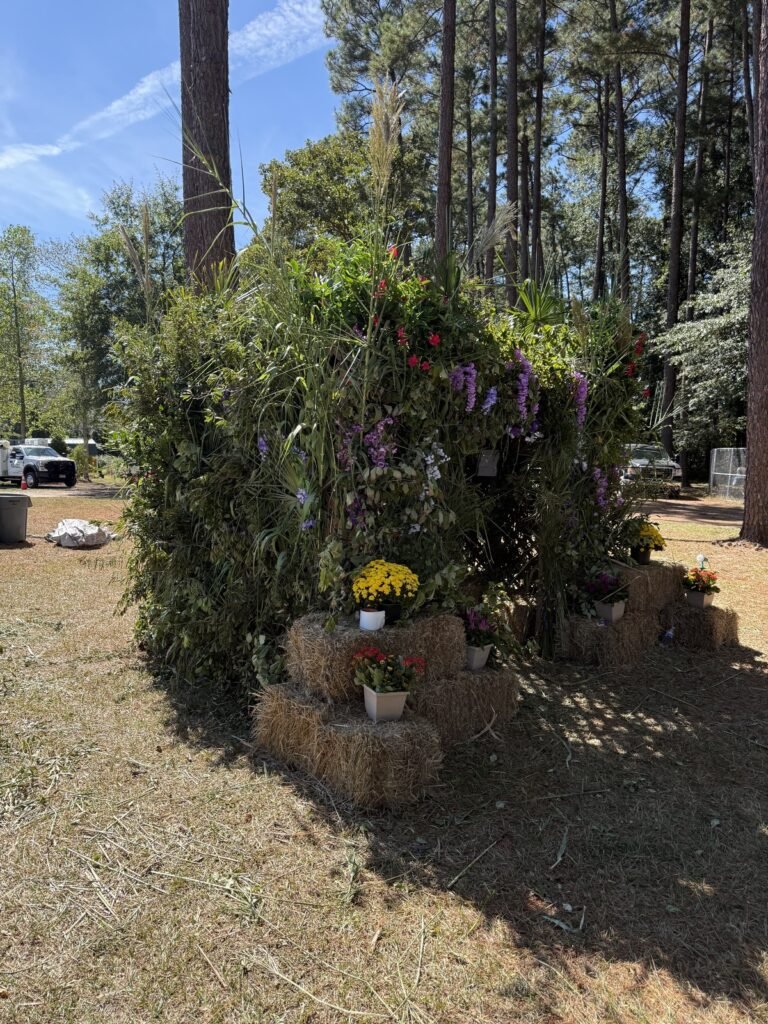
At the beginning of Sukkot, the decorations are beautiful.
Branches cover the shelter. Leaves fill the openings. Flowers add color. Everything looks green, alive, and full of purpose. We gather beneath it, enjoy it, and thank God for the beauty.
But something has already changed.
The greenery has been cut away from the soil that fed it. It may still look alive today. It may remain lovely for several days. Yet slowly the leaves will curl, the flowers will droop, and the color will fade.
Why?
Not because the beauty was false. The beauty was real.
It fades because it has been separated from the source that sustained it.
That is not a symbolism the Torah assigns to the branches. It is simply something we can see while sitting in the sukkah—and it offers a wise question about our own lives.
Free printable reflection
Rejoicing in What Does Not Last
The Torah commands Israel to celebrate the Feast of Tabernacles for seven days. The people were to gather branches, rejoice before the LORD, and live in temporary shelters so that later generations would remember how God made Israel dwell in booths when He brought them out of Egypt (Leviticus 23:39–43).
Sukkot does not ask us to pretend that temporary things are permanent. It teaches us to rejoice in them while remembering the One who provides them.
The shelter is temporary. The harvest is seasonal. The decorations fade. Even our strongest seasons do not last forever.
Yet the command is still to rejoice.
This is not shallow happiness. It is joy with its eyes open. It receives beauty as a gift without confusing the gift with the Giver.
Still Green Is Not the Same as Still Rooted
There is a difference between looking alive and being connected to life.
A cut branch may stay green for a while. Yesterday's nourishment can remain visible even after the connection has been broken. The same can happen within us. We may continue working, smiling, producing, and even speaking the right words while our inner life is becoming dry.
Scripture repeatedly describes a faithful life as one that remains near its source.
Psalm 1 says that the person who delights in the instruction of the LORD “is like a tree planted by streams of water, yielding its fruit in season, whose leaf does not wither” (Psalm 1:3 BSB).
Jeremiah gives a similar picture: “Blessed is the man who trusts in the LORD, whose confidence is in Him. He is like a tree planted by the waters that sends out its roots toward the stream” (Jeremiah 17:7–8 BSB).
Jeremiah is not offering a vague promise that faithful people will never face heat or drought. His contrast is about trust: Judah had looked to human strength, foreign alliances, and false gods for security. The rooted tree pictures the person whose confidence remains in the LORD even when the hard season comes.
The strength of the tree is not merely in the appearance of its leaves. Its life comes from where its roots reach.
That is wisdom: knowing that visible beauty is not self-sustaining, and neither are we.
Jesus and the Source of Life
Jesus used the same living picture with His disciples:
“Remain in Me, and I will remain in you. Just as no branch can bear fruit by itself unless it remains in the vine, neither can you bear fruit unless you remain in Me.”
—John 15:4 BSB
Jesus was not speaking about Sukkot in that moment. But His words help us understand what the fading branches can reveal.
We do not create life within ourselves. We receive it.
We can decorate a life. We can make it look successful. We can keep yesterday's color visible for a while. But no amount of appearance can replace abiding in the One from whom life comes.
Remaining in Jesus is not decorating a life with religious language. It is dependence: receiving life from Him and allowing His life to bear fruit through ours.
The question is not simply, “Do I still look green?”
The better question is, “Am I still connected to the Source?”
Receive the Beauty. Remember the Source.
The fading of the greenery does not make the first day's beauty meaningless. It makes it precious.
Enjoy the flowers. Sit beneath the branches. Share the food. Welcome others. Give thanks for the harvest, the people at the table, and the mercy that has carried you this far.
But let every good gift point beyond itself.
Sukkot remembers that Israel's life in the wilderness did not depend upon permanent houses, abundant fields, or human control. Their security rested in the God who brought them out, sheltered them, fed them, and remained faithful to His covenant.
Our lives are also more fragile than they appear. Health changes. Seasons pass. Work ends. Possessions wear out. Human praise moves on. None of these things is evil, and many are genuine gifts. They were simply never meant to be the source of our life.
So perhaps the sukkah gives us a question worth carrying through the week:
What am I asking to sustain me that was only meant to be received as a gift?
And then a second question:
What would it look like for me to remain in Jesus today—not merely to look alive, but to draw life from Him?
The leaves will fade. The flowers will fall. The shelter will come down.
But the wisdom of the week can remain:
Receive the beauty. Rejoice in the gift. Remember the Source.
Find the Way—Meet Rabbi Jesus.
Walk the Way — Modern Mind, Ancient Book.
Scripture and research
- Leviticus 23:39–43; Deuteronomy 16:13–15; Psalm 1:1–3; Jeremiah 17:5–8; John 15:1–5
- Scripture quotations: Berean Standard Bible, third printing
- The Lexham Bible Dictionary, “Booths, Feast Of”
- Dictionary of the Old Testament: Wisdom, Poetry & Writings, p. 432, “Imagery for the Fruitful Life of Wisdom”
- The Bible Knowledge Commentary, vol. 1, p. 1151, “Jeremiah 17:5–8”
- Jeremiah 1–29, p. 146, “Jeremiah 17:5–8”
- New Testament IVb: John 11–21, p. 165, “15:4 Reciprocal Abiding of Branch and Vine”
Free printable reflection