Why did the first day of the week become special to followers of Jesus?
The clearest answer is the resurrection. Jesus rose on the first day. But the Bible’s fall calendar gives us a beautiful pattern for thinking about what that day means.
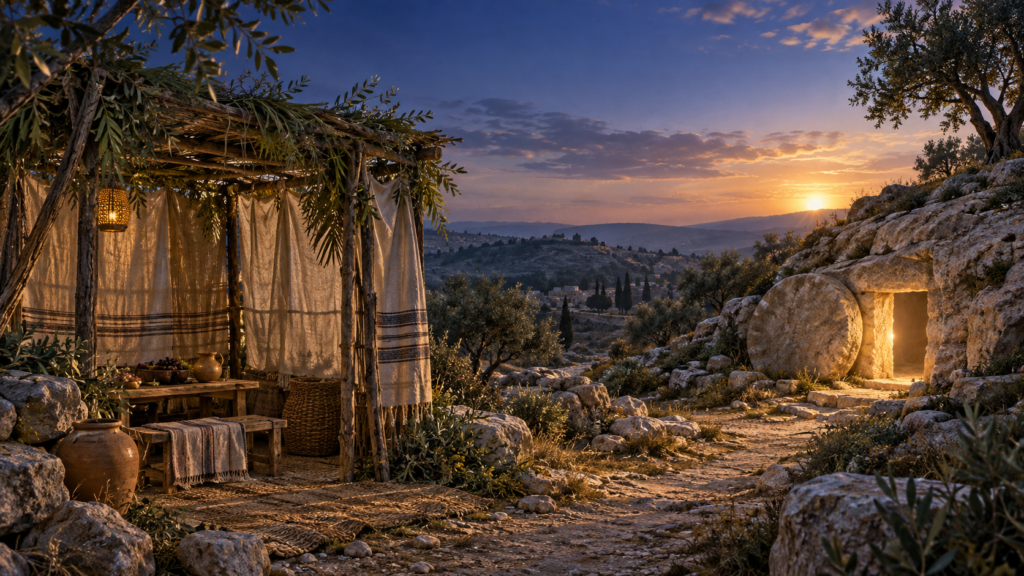
Sukkot—pronounced “Sue-Coat”—is the seven-day Feast of Booths, also called the Feast of Tabernacles. Israel was commanded to rejoice before God, remember His care in the wilderness, and dwell for a time beneath temporary shelters.
Then the Torah adds something striking: after the seven days comes an eighth-day assembly.
Seven days—and then an eighth
Leviticus 23:36 says:
“For seven days you are to present a food offering to the LORD. On the eighth day you are to hold a sacred assembly and present a food offering to the LORD. It is a solemn assembly; you must not do any regular work.”
Leviticus 23:39 describes complete rest on both the first day and the eighth day.
In Jewish life, this eighth day is known as Shemini Atzeret, meaning “eighth-day assembly.” It follows the seven days of Sukkot. It is connected to the feast’s sequence, yet Jewish practice also treats it as a festival with its own character. That distinction matters. We should not flatten a rich biblical and Jewish observance into a convenient Christian symbol.
The biblical pattern itself, however, is clear: seven days reach their completion, and then an eighth day is set apart before God.
The first day Jesus made unforgettable
All four Gospels place the discovery of the empty tomb on the first day of the week.
John 20:1 says:
“Early on the first day of the week, while it was still dark, Mary Magdalene went to the tomb and saw that the stone had been removed from the entrance.”
That evening, while the disciples were together behind locked doors, Jesus came and stood among them. His greeting was simple and immense: “Peace be with you!”
Jesus rose on the first day. That day would never be ordinary again.
How can one day be both first and eighth?
A week has seven days. The day after that completed seven begins a new week, so it is the first day. But if we look backward and continue counting beyond the completed seven, the same day can also be spoken of as an eighth day.
This is not a claim that the calendar contains an eighth weekday. It is a theological way of seeing a new beginning after completion.
The Gospels never say that Jesus rose during Sukkot. The New Testament never explicitly identifies Sunday with Shemini Atzeret. We should not claim either one.
But I believe the eighth-day pattern surrounding Sukkot gives us a meaningful shadow of resurrection.
On the first day of the week, Jesus stepped out of the grave. The old week had ended. Death had done its worst. Then God brought life where death appeared to have the final word.
Jesus made that first day special—not by erasing everything that came before it, but by making it the morning of resurrection.
Eight days later: peace for Thomas
John adds another beautiful detail. John 20:26 says:
“Eight days later, His disciples were once again inside with the doors locked, and Thomas was with them. Jesus came and stood among them and said, ‘Peace be with you.’”
The risen Jesus meets fearful people with peace. He meets Thomas’s doubt with His wounded, living presence.
This verse does not prove a Sukkot connection. It does deepen John’s first-day resurrection scene with another gathered appearance “eight days later.” The emphasis remains Jesus Himself: crucified, risen, present, and worthy of faith.
Did Sunday replace the Sabbath?
This article is not making that claim.
Acts 20:7 records believers gathering to break bread on the first day of the week. In 1 Corinthians 16:2, Paul tells believers to set aside their gifts on the first day of every week.
These passages show that the first day gained a particular place in the life of Jesus’ followers. They do not, by themselves, settle every question about Shabbat, Sunday, and later Christian practice.
The most responsible statement is also the most beautiful: the resurrection gave the first day a new glory.
By the middle of the second century AD, Justin Martyr explained that Christians gathered on the day called Sunday because it was the first day of creation and the day Jesus rose from the dead. An earlier Christian writing, the Epistle of Barnabas, explicitly used “eighth day” language for the resurrection day. These writings are not Scripture, and MMAB does not adopt their polemics against Jewish practice. They do show that Christians were reflecting on the first day, the eighth day, creation, and resurrection very early.
Sukkot, dwelling, and creation made new
Sukkot teaches Israel to remember God’s provision and His presence through a temporary dwelling.
The Gospel of John says that the Word became flesh and made His dwelling among us. The Greek wording carries the sense of pitching a tent or tabernacling among us. Revelation carries that theme to its promised fullness:
“Behold, the dwelling place of God is with man, and He will dwell with them.”
—Revelation 21:3
The resurrection of Jesus is not merely one surprising morning in the past. It is the beginning of the new creation.
Jesus rose to live for us and to bring us to Himself, when He will tabernacle with us.
That is where the eighth-day reflection becomes an invitation. The temporary shelter reminds us that the present age is not permanent. The empty tomb tells us that death is not permanent either.
A simple way to remember
During Sukkot, gather your household or a few friends for a meal.
- Read Leviticus 23:33–44.
- Read John 20:1–20.
- Thank God for specific ways He has carried and provided for you.
- Thank Jesus for His resurrection.
- Pray for your home to become a place of welcome.
- Make room at the table for someone who might otherwise be alone.
This simple practice is not a replacement for a congregation’s Sukkot observance or a claim that an ordinary outdoor meal is a complete ritual sukkah. It is an invitation to begin learning with Scripture, gratitude, hospitality, and Jesus at the center.
The day after seven is not an escape from God’s story. In Jesus, it is the beginning of creation made new.
Find the Way—Meet Rabbi Jesus.
Walk the Way — Modern Mind, Ancient Book.
Scripture and sources
- Leviticus 23:33–44; Numbers 29:35–38; Nehemiah 8:18
- Luke 24:1–7; John 20:1–29; Acts 20:7; 1 Corinthians 16:2
- John 1:14; Revelation 21:1–5
- Scripture quotations: Berean Standard Bible, third printing
- What Is Shemini Atzeret / Simchat Torah? — Chabad
- Shemini Atzeret: Core Concepts — Sefaria
- Justin Martyr, First Apology 67 — CCEL
- Epistle of Barnabas 15 — New Advent